The Marina Bay Sands casino complex in Singapore says its “pursuit of food sustainability” covers “reducing food waste at source through artificial intelligence,” as well as “donating to communities in need, and processing food waste” via pioneering technology.
Marina Bay Sands, promoted by Las Vegas Sands Corp, is one half of Singapore’s casino duopoly. The resort had a soft launch in April 2010, and its full opening was in June 2010, meaning it is celebrating its 15th anniversary this year.
In a recent press release, the casino complex said it has made “significant progress” on “circular waste management practices,” via a “range of innovative food waste treatment” practices done on a pilot basis.
“These complement five aerobic digesters capable of breaking down food waste into non-potable water for discharge,” machines that were introduced to its operations “early on in 2013,” it added.
According to the announcement, Marina Bay Sands completed in 2024 a two-year piloting of “WasteMaster”, a food waste processing technology that “transforms high-calorific output into fish feed for a local aquaponics farm”.
“Waste subsequently excreted by the fish is broken down by beneficial bacteria into nitrates, which are then used to fertilise high-quality vegetables in a local farm,” which were then “sold in selected supermarkets and restaurants”. It added: “This technology continues to be used in 2025.”
Meridith Beaujean, executive director of sustainability at Marina Bay Sands, said in prepared remarks: “These pioneering trials demonstrate Marina Bay Sands’ commitment to pushing the frontiers in the hospitality and sustainability industries in Singapore while reducing the environmental impact of our operations.”
She added: “Through various technologies and best practices, we diverted 65 percent of our food waste in 2024, and hope to achieve 100 percent by end-2025.”
The update said the casino resort “processes and diverts up to 12,000 kilos of food waste daily,” and that, since 2013, “close to 10 million kilos of food waste have been diverted from landfills through food waste management technologies and donations to charity partners”.
In the same announcement, Marina Bay Sands said it had deployed a fleet of 12 autonomous mobile robots (AMRs) for back-of-house deliveries for its hotel and convention centre operations.
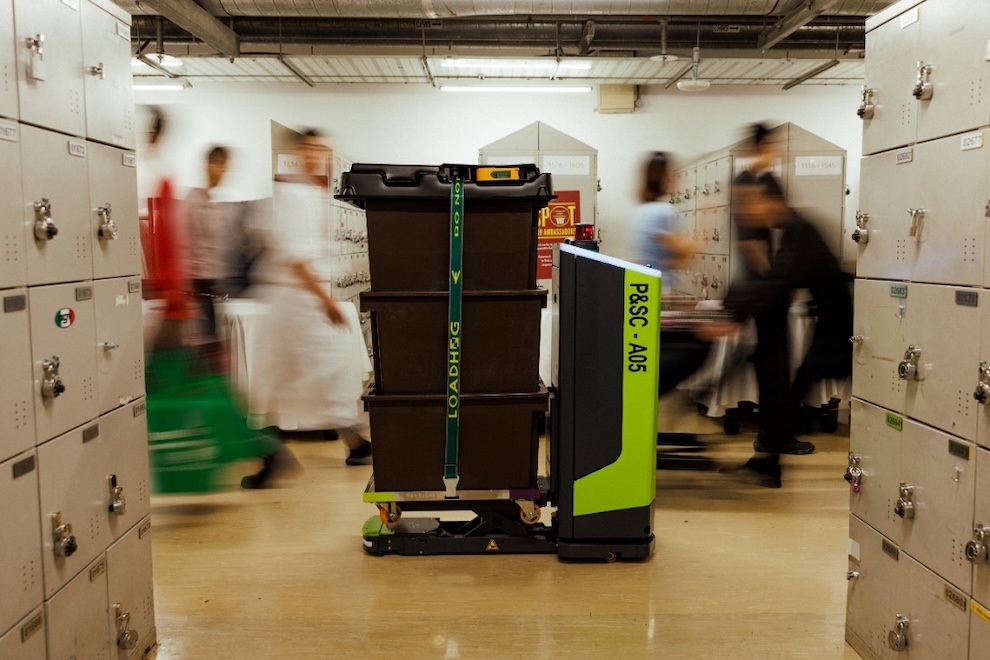
Typically deployed for supply chain deliveries in factories around the world, the AMRs (pictured above) at Marina Bay Sands will “perform a critical but manpower-laborious task of deliveries” for the complex.
“With the use of the AMRs, Marina Bay Sands has seen up to a 30 percent reduction in labour dependency,” stated the release.
It added: “Procurement and supply chain team members have been re-assigned to higher value tasks, upskilling in areas such as inventory management as well as operating and dispatching the AMRs, ensuring the smooth integration of robots into daily operations.:
Another five AMRs will be programmed and put into operation in the second half this year, it stated.
According to the complex, to-date, “more than 200 work processes have been automated across various business functions, allowing the resort to repurpose over 162,000 manhours towards greater value-added tasks annually”.