Two Macau casino resort operators saw sequential improvement in the third-quarter net revenues of shopping malls they respectively run at their Cotai properties.
The gains for Galaxy Entertainment Group Ltd and Sands China Ltd coincided with other official economic data indicating stengthening demand for luxury goods in Macau shops generally, and for retailers on the Chinese mainland.
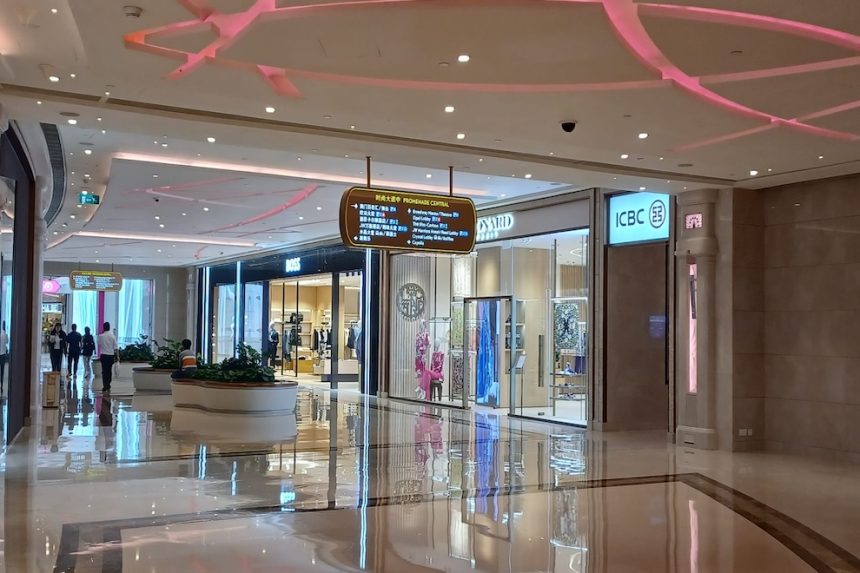
Third-quarter mall net revenue at Galaxy Macau (pictured) – Galaxy Entertainment’s flagship gaming complex in Cotai – was HKD340 million (US$43.7 million), up 3.7 percent sequentially. It was nonetheless down 2.0 percent from a year ago.
The third-quarter results took Galaxy Macau’s mall net revenue for the first nine months this year to HKD1.00 billion. While that was down 3.9 percent year-on-year, the decline narrowed relative the first nine months of 2024, when its mall net revenue declined 12.7 percent year-on-year to HKD1.04 billion. That is based on GGRAsia’s review of the prior-year’s results filings.
Sands China’s Cotai malls saw aggregate net revenue for the first nine months this year at US$379 million, up 6.5 percent from the prior-year period. That is according to third-quarter results filed by its U.S.-based parent, Las Vegas Sands Corp.
The main Sands China malls are at its Cotai properties: The Venetian Macao; The Londoner Macao; the combined The Plaza Macao and Four Seasons Macao; and The Parisian Macao.
Their collective net revenue during the third quarter reached US$130 million, up by circa 4.0 percent sequentially and year-on-year.
Those malls’ tenant-occupancy rate – the gross leasable occupied area divided by gross leasable area at the end of the reporting period – all improved year-on-year up to September 30 this year.
The Sands China’s parent said in its third-quarter results issued in October, and referring to the Macau-mall revenue for the first nine months: “The increase of US$22 million [year-on-year] at our Macau operations was primarily driven by increases of US$15 million in overage [extra] rent, US$4 million in base rent and US$3 million in revenues related to CAM [common area maintenance].”
Sands China and Galaxy Entertainment had respectively added new offerings to their malls up to the end of the third quarter: either relaunched luxury outlets or additional retail brands. That is based on GGRAsia’s observation of the operators’ respective promotional materials, and recent site checks.
Signs of recovery
The better third-quarter performance of the Cotai malls of those two casino operators coincided with an improvement in reportable retail sales citywide in the period, indicated data from Macau’s Statistics and Census Service.
Macau-wide, the reportable retail-sales tally was MOP16.96 billion (US$2.11 billion) in the three months to September 30, up nearly 6 percent from the previous quarter. Judged year-on-year, such sales were up 2.2 percent, ending a decline trend seen in six consecutive quarters previously.
The statistics service said cosmetics, jewellery, and pharmacy products helped Macau’s third-quarter retail figures.
Greater China appeared to be “bottoming out” from a decline previously seen in demand for luxury goods, financial institution Macquarie Capital wrote in a late November memo.
In 2024, “the global personal luxury goods segment” had “experienced its first contraction in 15 years (excluding the Covid-19 period), with market value dipping 2 percent to EUR363 billion [US$422.6 billion] … per Bain & Co,” wrote Macquarie analysts Linda Huang, Terence Chang and Sunny Chow in the memo.
They highlighted that luxury retail’s performance in the Greater China region regarding brand houses such as LVMH, Hermès and Richemont, had seen sequential improvement in the July to September quarter.
The analysts noted: “We believe third quarter of 2025 highlighted a significant inflection point and improvement in Greater China luxury demand – the crucial factor that drives a sector rebound.”
The Macquarie analysts attributed the recovery in Greater China’s luxury goods demand to factors including the “wealth effect due to stock market rally” in the region, and “overseas luxury consumption [coming] back to China”.
“Luxury groups are strategically recalibrating their retail footprint, prioritising efficiency, higher sales density, and enhanced customer experiences over network expansion and aggressive price increases to drive business growth,” the Macquarie analysts also remarked.