Jeju’s collection of eight foreigner-only casinos is at a crossroads, in the face of increasing competition for gambler spend across Asia-Pacific, and declining business prospects for some of the Jeju venues.
That is according to some industry commentators spoken to by GGRAsia.
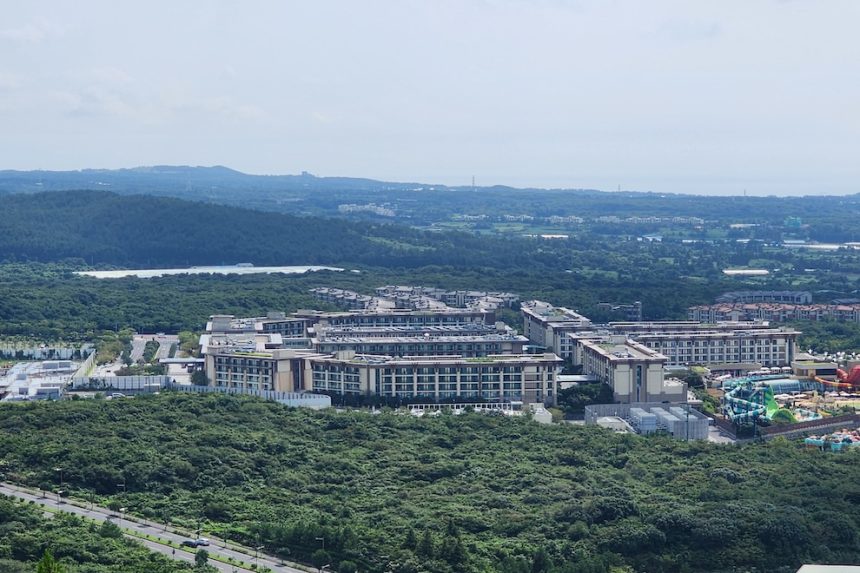
Amanda Ga is associate vice president for external affairs at Jeju Shinhwa World, which opened on Jeju island in October 2017 as a purpose-built resort (pictured), with its foreigner-only casino launched in February 2018. She suggested some fixes for the island’s gaming industry.
Ms Ga told GGRAsia that a challenge for Jeju – a semi-autonomous South Korean territory off the southern coast of the Korean peninsula – was not that there were too many casinos, but that there was a need for strategic integration of the marketing of the island to visitors, and of air transport to get there.
“If tourism, MICE, air routes and content had been designed together, eight casinos wouldn’t be an issue,” she stated. She was referring secondly to meetings incentives, conferences and exhibitions business (MICE). That is traditionally used by the gaming industry globally, to fill hotel rooms at integrated resorts (IRs) and casino hotels during quieter periods for general tourism.
Ms Ga added that Jeju’s challenge was to have “functional redesign and long-term restructuring” of its overall marketing and tourism offer.
Felix Lee, a casino industry commentator, told GGRAsia that Jeju casino licensing stems from a boom in tourism from Japan in the 1980s and 1990s, when the local issuing authorities initially had no experience in managing the casino sector.
Mr Lee is a former executive responsible for management innovation, at Grand Korea Leisure Co Ltd, a foreigner-only casino operator in South Korea with three venues on the mainland.
Open-ended licences
All current Jeju licences are issued without either a time limit, or any specific conditions about bringing particular benefits to the local economy, according to recent commentary from local government sources to GGRAsia.
Ms Ga favours the Jeju licence regime evolving to have regular evaluations on operators’ environmental, social and governance practices; as well as licensees’ impact on local employment and the community.
Mr Lee told GGRAsia that permanent licences – when judged globally – were “atypical”.
He favoured renewable, performance-based licensing already mooted by the Jeju authorities, and of the sort found in some major international markets.
The Jeju market’s 2024 gross gaming revenue (GGR) was mostly in the hands of the island’s two large-scale IRs.

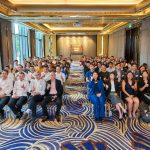
That year Jeju Dream Tower (pictured, above) in downtown Jeju city, run by Korea Exchange-listed Lotte Tour Development Co Ltd, had 69.8 percent of the island’s KRW458.91-billion (US$312.2-million currently) annual gaming revenue, as per national government data reviewed by GGRAsia.
According also to the Ministry of Culture, Sports and Tourism’s data, Jeju Shinhwa World’s share of Jeju-market 2024 GGR was 15.1 percent.
Ms Ga told GGRAsia the goal should be to expand the Jeju gaming market’s size, rather than to expect Jeju’s eight operators to fight intensively over the existing pie.
According to data from the Jeju Tourism Association, the island is currently mainly a domestic tourism spot.
It had an aggregate of nearly 10.17-million visitors in the nine months to September 30, down 3.2 percent year-on-year. But of that cohort, fewer than a fifth – i.e., circa 1.74 million – were actually from overseas, though the tally did rise 15.6 percent year-on-year.
Visa-free arrival
The island restarted on June 1, 2022 – following a pause during the Covid-19 pandemic – a visa-free programme open to many international travellers arriving there directly.
Currently though, most scheduled-airline flights to Jeju are via the Korean mainland, from either Incheon, Gimpo, or Busan airports. Foreigners arriving in Jeju via the Korean mainland still need Korea Electronic Travel Authorization (K-ETA) clearance, even if they qualify for visa-free entry into South Korea.
As per the Jeju Tourism Association, in the first nine months of this year, Chinese tourists accounted for the largest share of foreign visitors to the island, numbering just over 1.28 million, or nearly 73.8 percent of the overseas-markets total. People travelling from Taiwan totalled 161,995 of the foreign arrivals.
The Chinese special administrative region of Macau received 29.67 million tourists from all destinations in the nine months to September 30, with 72.7 percent of them, or nearly 21.58 million, from the Chinese mainland. Macau has no nationality-based restrictions on gambling.
The idea of liberalising South Korea’s casino industry to end the local-player monopoly of Kangwon Land Inc on the Korean mainland – including possibly a locals casino on Jeju – has been mentioned from time to time.
But Ms Ga suggested “cultural and social problems make a near-term introduction doubtful”. She added such discussion should be in the context of a “comprehensive tourist and MICE plan,” for Jeju and for the country a whole.
She further noted, referring to under-construction MGM Osaka, Japan’s IR, due to open in 2030: “Osaka illustrates that integrated resort ecosystems, not domestic gambling, have the economic benefit.”
According to Mr Lee, Jeju’s relative geographic isolation makes it a viable “pilot” site for locals gambling, provided there were safeguards such as high entry fees and limitations on frequency of visits.
Developing better air connectivity to Jeju directly from overseas remains one of the biggest challenges to expanding Jeju’s existing foreigner-only casino business model, say both experts.