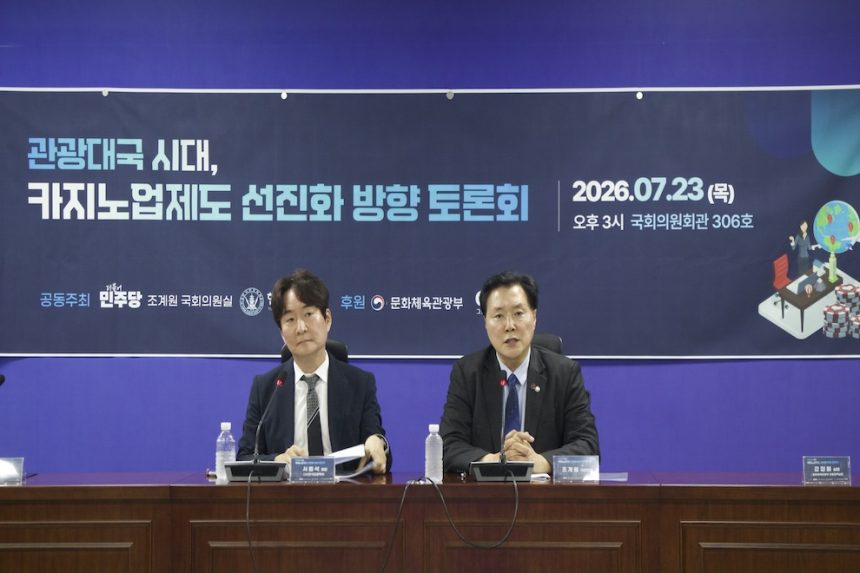
A “Forum on the Modernisation of the Casino Industry” held at South Korea’s National Assembly on Thursday, heard some criticism directed at proposed reforms to the country’s casino regulatory framework.
The gathering brought together government officials, casino operators, other industry representatives, and academics.
The event was fronted by Cho Gye-won (pictured right), a lawmaker from the governing centre-left Democratic Party of President Lee Jae Myung. The forum moderator was Professor Seo Won-seok (pictured left), of Kyung Hee University, and President of the Tourism Sciences Society of Korea.
During the forum, attended by GGRAsia, South Korea’s government defended proposed reforms to casino regulation. These include a plan to raise the maximum Tourism Promotion and Development Fund contribution from 10 percent to 15 percent of a casino’s annual gross gaming revenue (GGR); as well as replacing the current permanent licensing system with renewable permits of five-year duration; and requiring investors to give the government prior notification of any plan for a change in controlling shareholder at a casino.
The government says the measures are intended to strengthen rather than constrain the industry. Casino operators, however, warned during Thursday’s session, that some of the proposals could undermine investment and competitiveness.
Opening the forum, government MP Mr Cho rejected suggestions the proposals were intended to tighten regulation of the casino industry. He mentioned that the idea of a five-year casino licence with a review and renewal process – rather than a perpetual licence save for cases of licence infringement – was meant to promote regular oversight and industry innovation.
Mr Cho stated: “The purpose is not to restrict the casino industry, but to establish a transparent and trusted regulatory system so the government can provide stronger policy support.”
Mr Cho added that a stronger casino sector could help revitalise tourism and regional economies, mentioning as an example the Honam region in the southwest of the country. There, North Jeolla Province has reportedly unveiled plans for an integrated resort with a locals-play casino in the Saemangeum land-reclamation area. Currently, only Kangwon Land Inc is the only entity permitted to run a casino open to South Koreans.
Minister’s view
Chae Hwi-young, the country’s Minister of Culture, Sports and Tourism – and therefore head of the department that oversees the casino industry – did not attend the session. But in a message published in the forum brochure, he described casinos as an important part of South Korea’s tourism industry and said the country’s regulatory framework had failed to keep pace with changes in the sector. He said the proposed reforms were intended to establish a fair and transparent system that would strengthen industry competitiveness and public trust.
Speaking at the forum, Lee Myeong-jin, the ministry’s Convergence Tourism Division secretary, said the country’s casino legal framework had remained largely unchanged for about 30 years despite significant changes in the industry’s operating environment.
He said reforms should strengthen competitiveness while improving transparency and regulatory credibility.
Former ministry official Kwon Kyung-sang, who worked to establish the current Tourism Promotion and Development Fund system in the 1990s, told the forum he opposed reintroducing licence renewals, saying they had originally been abolished because they created lobbying, and regulatory uncertainty.
He also argued that the country’s 17 foreigner-only casino licences should be regulated separately from Kangwon Land Inc and its Kangwon Land venue. But he did support the idea that policymakers consider expanding locals-play casinos as part of broader deregulation efforts.
Mr Kwon said no other country he was aware of, levied a tourism-fund contribution based on a casino’s GGR. He warned that increasing regulatory or financial burdens on foreigner-only operators could deter investment and potentially lead to legal disputes.
He also called for casino-related provisions to be removed from the Tourism Promotion Act and incorporated into a standalone Casino Act.
Industry opposition focused most heavily on the proposal to raise the maximum Tourism Promotion and Development Fund contribution from 10 percent to 15 percent.
Japan’s competitive threat
Choi Seong-wook, chairman of the Korea Casino Association (KCA), told the forum the higher ceiling would significantly reduce operators’ profitability, weaken financing conditions for projects including Inspire Entertainment Resort and Jeju Dream Tower, and erode South Korea’s competitiveness ahead of the opening of an Osaka integrated resort (IR) with casino in Japan. MGM Osaka is due to launch at the end of 2030.
The KCA had issued a statement on Tuesday, outlining some of its concerns about proposed regulatory reforms. The body estimated that increasing the maximum tourism fund contribution to 15 percent of GGR would raise annual payments by approximately KRW76.3 billion (US$51.8 million) for three major Korean-mainland casino operators, and by about KRW101.9 billion if one operator in Jeju was included.
Kang Daesuk, executive director of the legal team representing Inspire Entertainment Resort, an Incheon-based complex with foreigner-only casino, said during a question-and-answer session at Thursday’s forum, that a tourism-promotion payment fund system should be based on objective and predictable criteria, warning that regulatory uncertainty could deter long-term foreign investment. “Which foreign investors would invest under such circumstances?” he asked.
Mr Kang said Inspire’s backers had invested more than KRW1.93 trillion (US$1.31 billion) in the resort since it started opening in stages from November 2023, much of it in non-gaming facilities, but had yet to reach break-even. He also warned that raising the Tourism Promotion and Development Fund contribution to as much as 15 percent of annual GGR – i.e., a contribution increase of up to 50 percent – would further add to the burden on foreign investors, and threaten jobs. He urged policymakers to recognise non-gaming investment, employment creation, and tourism promotion as public contributions, rather than focusing solely on fund payments.
International standards
Kim Na-na, director of the ministry’s Convergence Tourism Division, said the government understood Inspire’s financial situation and would take operators’ circumstances into account. She defended the proposed licence-renewal system as an international standard, saying most casino jurisdictions periodically review operators’ compliance.
Ms Kim also rejected media reports suggesting the proposal would automatically increase operators’ tourism-fund payments by 50 percent, saying the maximum 15-percent rate on GGR would apply only to future revenue bands to be set by presidential decree after consultation with the industry, rather than all operators. She added that contributions based on GGR were common internationally and were reinvested in tourism infrastructure and inbound tourism promotion.
Kang Sung-hoon, a director at Lotte Tour Development Co Ltd, operator of the Jeju Dream Tower casino-resort on the country’s holiday island of Jeju, questioned at the end of the forum why the three reform proposals – covering the Tourism Promotion and Development Fund; licence renewal; and prior approval for ownership transfers – had been advanced without first demonstrating shortcomings in the current system.
He asked policymakers to explain what problems had arisen under indefinite licences; the existing 10-percent ceiling on annual gaming-revenue contribution to the Tourism Promotion and Development Fund; and the current ownership-transfer regime, noting that Jeju’s casinos already contribute about KRW62 billion of the island’s KRW77 billion Tourism Promotion and Development Fund revenue.
Among questions put to the forum by attendees was why South Korea continued to restrict all but one of its casinos to foreign customers, while at the same time advocating international standards of regulation, which the speaker argued mostly allowed locals, even if with some entry fees or other safeguards.
The ministry officials did not respond on the spot to questions from the floor, citing time constraints.