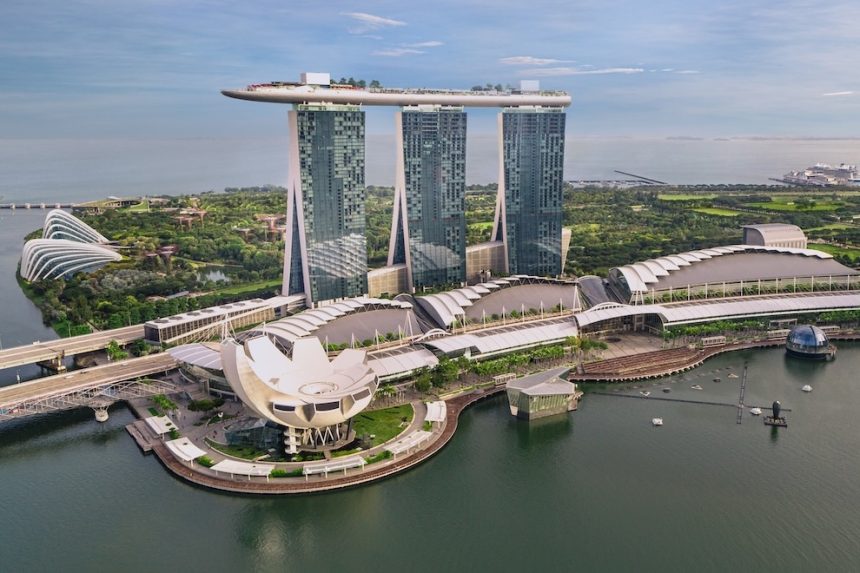
Marina Bay Sands’ record-level second-quarter earnings before interest, taxation depreciation and amortisation (EBITDA) of US$768 million was US$107-million higher than might have been expected on a hold-adjusted basis, says Seaport Research Partners. It added that side bets in likelihood helped.
The institution gave the comment in a note following Wednesday’s second-quarter results from Las Vegas Sands Corp, the parent business of Singapore casino resort Marina Bay Sands.
Senior analyst Vitaly Umansky wrote of the Singapore property: “Hold-adjusted EBITDA would be US$661 million (+47.5 percent year-on-year, +9 percent quarter-on-quarter), and margin of 52.8 percent.
“However, we believe theoretical hold was likely higher than the company’s adjustment to 3.7 percent, due to higher propensity for higher casino edge side-bets which have shown increasingly stronger popularity” at the property, he added.
Robert Goldstein, chairman and chief executive of Las Vegas Sands, had said on the group’s earnings call, referring first to table-based technology designed to enhance financial security and integrity for casino table games: “We’re really confident that this new era of ‘smart tables’, side bets – which is increasing hold percentage for everyone, all of our competitors as well – is highly positive for the industry and exciting for the customer.”
In October GGRAsia had reported industry commentators suggesting that new-to-Macau baccarat side bets commonly referred to as ‘Lucky 7’ and its variation ‘Super Lucky 7’ had the potential to mirror the success of a Singapore-market variant known as ‘Dragon Tiger’ baccarat, offered at Marina Bay Sands.
CBRE Equity Research said in its Thursday view of the Marina Bay Sands’ second quarter: “Marina Bay Sands is benefitting from a multibillion-dollar reinvestment programme, with the suite renovations now fully complete and more amenities on the way throughout 2025 and 2026 including an additional lobby, [revamped] SkyPark, and food and beverage/wellness amenities.”
Analysts John DeCree and Max Marsh added: “Las Vegas Sands also broke ground last week on a US$8-billion Marina Bay Sands expansion project, which is expected to open in 2031 and will include a new 570-suite luxury hotel tower, a 15,000-seat arena, additional MICE [meetings, incentives, conferences and exhibitions] and entertainment amenities, and premium gaming areas.”
Sands China player reinvestment
Las Vegas Sands is also the parent of Sands China Ltd, one of Macau’s six casino concessionaires.
In the Macau market, where Las Vegas Sands has pledged to boost EBITDA performance, Sands China had been “playing a bit of catch up” with the rest of the market in terms of the money it spent on player incentives and retention – known as player reinvestment, said Seaport’s Mr Umansky.
JP Morgan Securities (Asia Pacific) Ltd has referred to the phrase ‘player reinvestment’ as “freebies provided to… players” as a percentage of each player’s value to the house in ‘theoretical win’ terms.
Seaport stated in its Thursday memo: “Reinvestment remains at all-time highs in Macau for premium players.”
Mr Umansky added: “Competition for premium players remains tough… We estimate that player reinvestment may be in the high 30s of percent for the largest premium mass players in Macau.”
CreditSights stated in a Thursday note on Las Vegas Sands that Sands China’s second-quarter total net revenues and EBITDA “eked out marginal year-on-year-growth largely thanks to the newly-renovated Londoner [Macao], though partially offset by its other casinos.”
Analysts Nicholas Chen and David Bussey added: “We expect further EBITDA contributions from the continued operational ramp up of The Londoner in second-half 2025, though EBITDA margin improvements will likely be limited by the company’s customer reinvestment programme.”