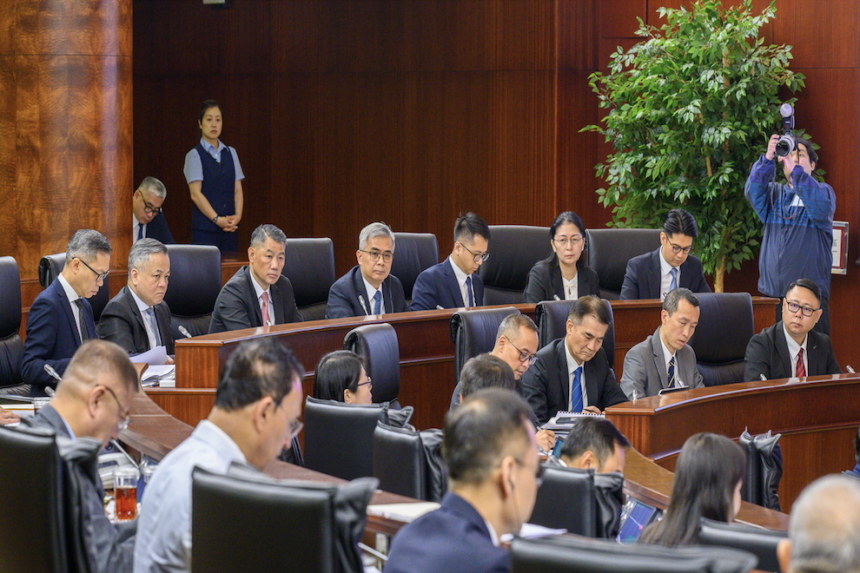
The criminalising of gaming-related unlicensed money exchange has been “effective” in combatting such activities, says Macau’s Secretary for Security, Wong Sio Chak
Mr Wong (pictured, back row, centre) added fewer instances of suspected unlicensed money-changing for gambling purposes being solicited by touts had been reported since the law came into effect.
He was speaking in response to a question from local legislator Lam Lon Wai, at a Friday plenary session of the city’s Legislative Assembly.
The meeting was a question-and-answer session on Macau’s Policy Address for Fiscal Year 2025 that had been announced in mid-April.
Mr Wong stated: “Following the criminalising… last year, the impact has been quite satisfactory.
“From the time it was criminalised till the end of last year, there were 89 such cases recorded: another 132 cases were recorded in the first quarter of this year,” said Mr Wong in his comments to the assembly.
“Since they [offenders] are left with a criminal record” on conviction, “and get any related cash or gaming chips seized,” such sanctions are “effective,” the security official added.
The step was included in Macau’s “Law to Combat Crimes of Illegal Gambling”, effective from October 29.
Unauthorised foreign-currency exchange for Macau gambling is considered a criminal matter if the city’s authorities deem it as being done as a trade activity, regardless of whether it takes place in or outside casinos. Such exchange activity can result in a penalty of up to five years’ imprisonment for those found guilty, the law says. These people could also face a Macau casino entry ban of “two to 10 years” in length.
Now that unlicensed money exchange for gaming is criminalised, it also opens the possibility for suspects to be charged under the general penal code, with “criminal association”, which can result in other penalties.
Mr Wong stated “If they [offenders] commit the crime in a group, they could be charged as a criminal association, which is even more effective.”
The official also mentioned that the number of alleged touts – typically people that solicit members of the public to use unlicensed money changers – that had been snared for promoting such activities had fallen since criminalisation.
In 2024, 1,292 touts had been identified in the first quarter. The tally was down to 923 in the second quarter; 620 in the third quarter and 350 in the final quarter, Mr Wong told the legislators. In the first quarter this year, the security authoroties identified 251 touts for unlicensed money exchange services, Secretary Wong also noted.
Enforcement against unlicensed money exchange activities was listed in the 2025 Policy Address as an “ongoing” key task for Macau’s security authorities.
According to that document, the departments under Mr Wong would be in charge of combatting “cross-border illicit money exchange activities” and the “black and grey industries” supporting them.
That was a reference to supporting activities deemed by the authorities as either outright illegal or ambiguous in nature.
The policy document said enforcement efforts against cross-border unlicensed money exchange activities would be strengthened via “reinforced” collaboration with China’s Ministry of Public Security.