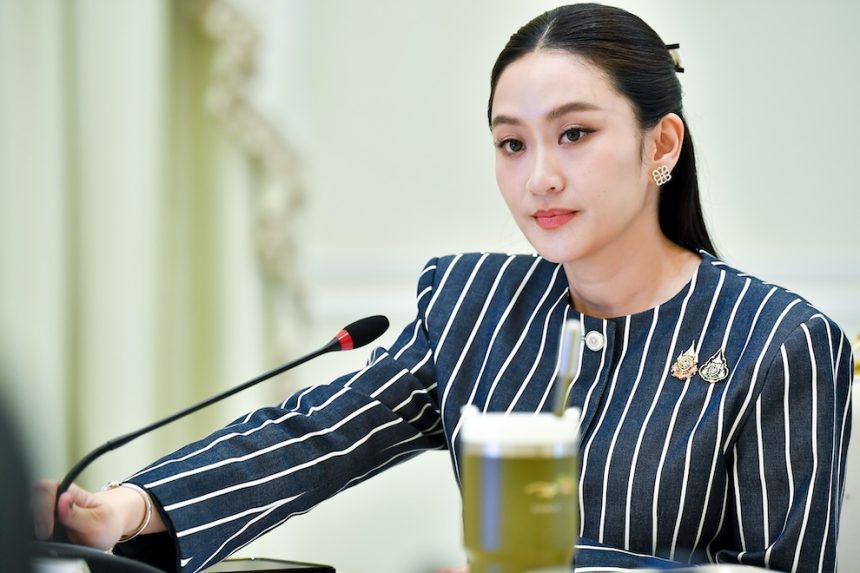
Thailand’s prime minister, Paetongtarn Shinawatra (pictured in a file photo), says MPs from her Pheu Thai Party have been given the job of explaining to the country’s people the “great national benefit” of having tourism resorts with casinos, known there as ‘entertainment complexes’.
Her party is a leading grouping within the coalition government.
Ms Shinawatra’s comments were reported by The Nation newspaper on Tuesday, following a cabinet meeting held away from the capital Bangkok, namely in Nakhon Phanom province, in the northeast of the country, near its border with Laos.
She was cited as saying of the casino policy: “This project involves foreign private sector investment, from which the government will be able to collect taxes – benefitting the country as a whole.
“Moreover, it will create employment opportunities through various activities, such as concert organisation, which in turn will lead to increased tax revenue.”
Maybank Securities (Thailand) PCL said in a recent memo it estimates “conservatively” annual revenue from Thai casino resorts of THB278 billion (US$8.33 billion currently), an amount it suggested would be “the fourth-largest in Asia”.
The institution also noted the proposed tax rate on gross gaming revenue was 17 percent, which it said was “attractive compared to regional peers, such as Singapore, Malaysia, the Philippines and Macau”.
According to the Tuesday report of the PM’s comments, she had also spoken with party leaders within the coalition supporting the government, to make sure they work to publicise the legalisation bill’s economic benefits, while also acknowledging each party could adopt its own approach on such communication.
In early April, the nine-MP Prachachat Party – a minority partner in the coalition, and which draws its support from the predominantly Muslim south of the country – issued a formal statement saying it “cannot accept the principles” of the bill to legalise casino gaming in the nation.
The declaration came amid public demonstrations against the casino policy.
Also in early April, the secretary-general of the Bhumjaithai Party, a key element in the coalition, said he would reject the Entertainment Complex Bill “no matter who proposed it”. Later the party said he was speaking in a personal capacity.
Those developments came as on April 8, Ms Shinawatra asked for a postponement of a reading of the Entertainment Complex Bill in parliament, due to more urgent government business.
The two main coalition parties have insisted there is no split regarding the casino policy.
In her remarks reported on Tuesday, Ms Shinawatra addressed concerns about the legislative process.
She was quoted saying: “We still have time before the next parliamentary session opens. We’ll do our utmost to move this [Entertainment Complex Bill] forward. What I presented to parliament, I believe, could be of great national benefit – otherwise, I would not have initiated this matter.”
One commentator recently told GGRAsia it might be “uncomfortably tight” timetable-wise for the coalition to get its Entertainment Complex Bill through the Thai parliament, and then have gaming licences issued by the first quarter 2027, on the basis the current government’s term expires in May that year.