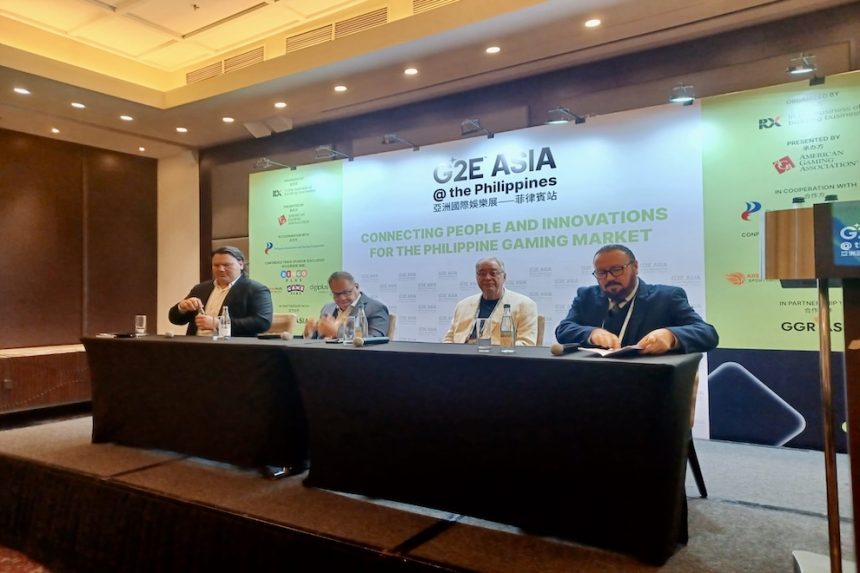
Philippine-licensed operators of app-based domestic online games are faced with the prospect of increased fees and reduced choice of game products as the price of staying away from the ‘grey’ unlicensed market. That was a view aired during a panel at Global Gaming Expo (G2E) Asia @ the Philippines 2025 on Wednesday.
Such app-based operators might therefore consider moving into the social casino sector, where players do pay for access, but for social entertainment games and not cash prizes. Such products might therefore not be classified as ‘gaming’ for regulatory purposes.
Those were some views presented at the panel “Navigating land-based and online frontiers amidst regulatory transformation”.
Evan Spytma, chief executive of Casino Plus – an online casino licensed by the Philippine Amusement and Gaming Corp (Pagcor) – mentioned the August decision by the Philippine authorities to order the country’s providers of electronic wallets to remove links that give access to online gambling platforms in the country.
He said it had actually removed safeguards such as know-your-customer and age verification. That was because registration to use such wallets was via a telecom customer’s SIM card.
When the delinking happened, not only did online revenue – and therefore Pagcor’s due fees – go down,” but “players were … left with nowhere to go. And then they started to explore all the grey sites, which were offering more rebates,” stated Mr Spytma.
Pagcor chairman and chief executive, Alejandro Tengco, had mentioned, in a Wednesday keynote address at the conference, a “sharp decline” in the agency’s income since August, which the regulator attributed to the delinking of online gambling platforms from e-wallets and a slight fall in the number of new players. Mr Tengco said, however, that this correction would in likelihood be a “short-term” one.
Mr Spytma said in his panel comments, regarding choice of slot games for Pagcor-licensed onshore operators via apps: “The most popular products are going to the grey market. So, you’re left with only Pagcor-approved games allowed on your site.”
“This is not on Pagcor, because these are external forces that are changing the market,” he noted, referring to the domestic political debate on the future of online gaming.
Industry consultant Ian Garner, who has worked across multiple jurisdictions in Southeast Asia, stressed that Pagcor understood the need for “good clean revenue” in the country’s gaming sector, including support for anti-money laundering (AML) protocols.
It had been “really important” that Pagcor had worked to get the country “off the grey list” of countries of concern regarding AML protocols, compiled by the Financial Action Task Force, he added.
Shaun McCamley, founder and chairman of GameWorkz, a developer of social gaming platforms designed to work with licensed land-based operators in the region, commented on the potential appeal of social gaming.
“It gives the properties free licence to brand and to market legally in the jurisdiction that they’re in,” he added. “Social [gaming] is not considered to be gambling,” he suggested.
The session was moderated by Niall Murray, chairman and chief executive, Murray International (Macau) Co Ltd, a industry consultancy. He is a former senior executive in the Macau and Las Vegas casino markets.