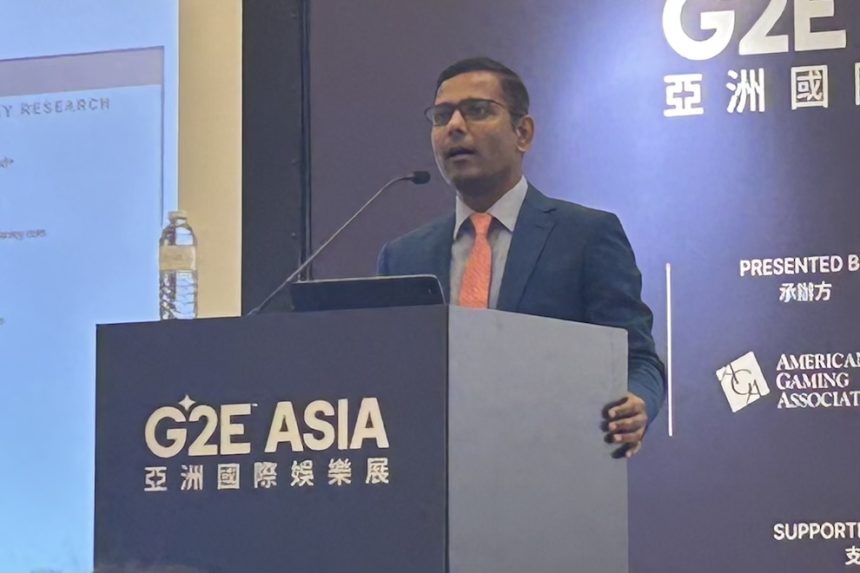
The land-based casino market in the Philippines is currently “really struggling”, and the lacklustre performance is likely to continue throughout 2026. That is according to Morgan Stanley managing director and head of Asian gaming and lodging, Praveen Choudhary (pictured).
The Philippines “used to be a very lucrative market,” but over the last couple of years returns “have come down significantly,” he said.
Mr Choudhary noted that arrivals to the Philippines from South Korea and China – two of its main sources of foreign visitors – were down by double digits in the first quarter, even after the country eased its visa policy for tourists from mainland China.
“All this global shutdown and online gambling is hurting this business for the Philippines,” he added. “I don’t have a view that 2026 will be better; it still looks challenging.”
His comments were made during a presentation on the opening day of Global Gaming Expo (G2E) Asia 2026, a casino trade show and conference taking place at The Venetian Macao. G2E Asia 2026 will run until Thursday (May 14).
Gross gaming revenues generated by licensed land-based casinos in the Philippines declined by 9.6 percent year-on-year to PHP182.50 billion (US$2.97 billion) in full-year 2025, according to official data disclosed last month.
In his presentation, Mr Choudhary covered a number of land-based casino markets in Asia, including Japan. He expressed doubts that the country’s first legal casino property – the under-construction MGM Osaka – would be able to open in 2030, as currently projected by promoter MGM Osaka Corp. The latter is a joint venture between casino operator MGM Resorts International and Japan-based Orix Corp, alongside other minority local investors.
“People are also talking about two more casinos opening in Japan,” he said. That was a reference to a national cabinet order issued on March 10 stating that the application period for a second round of integrated resort bids would run from May 2027 to November 2027.
“I personally don’t think anybody should spend time on that thesis. Just chill – it takes a lot of time,” Mr Choudhary stated.
Discussing another market in the process of opening up – the United Arab Emirates – he was bullish about its prospects, highlighting the current monopoly position of the Wynn Al Marjan Island project, being developed by U.S.-based Wynn Resorts Ltd.
“This market is great. I mean obviously luxury is all,” he said. “It totally makes a lot of sense.”
“Whatever’s going on in the Middle East, we need to figure out when people will start travelling to that area,” Mr Choudhary stated, in reference to the current regional conflict involving the United States and Iran.
Management at Wynn Resorts said earlier this month that the firm expected “a modest delay” in the opening timeline for Wynn Al Marjan.
The US$5.1-billion property – in which Wynn Resorts has a 40-percent equity stake – had been due to open in the spring of 2027.
The Morgan Stanley analyst noted that the overall gaming market in Asia had already “fully recovered” in 2025 to 2019 levels, before the onset of the Covid-19 pandemic.
Discussing Macau market dynamics, Mr Choudhary said the current focus of operators was on improving margins related to earnings before interest, taxation, depreciation, and amortisation (EBITDA).
He also highlighted the comeback of VIP gambling in Macau, with growth that “has been faster” than in the mass-market segment over the past two years.