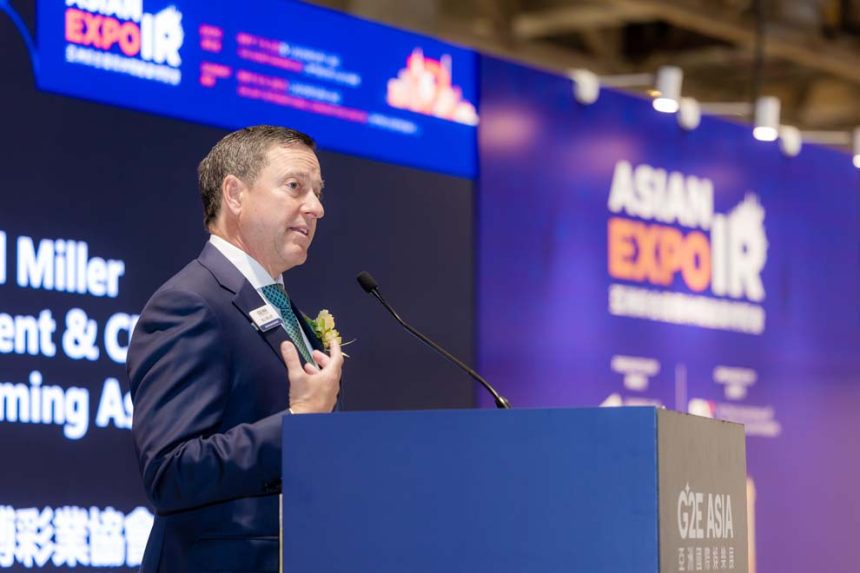
The Las Vegas-style integrated resort model developed in the United States continues to serve as a template for casino markets across Asia and beyond, according to Bill Miller (pictured in a file photo), president and chief executive of the American Gaming Association (AGA).
Mr Miller noted that the “American blueprint for gaming” is “increasingly… something that countries look to and say ‘We’d like to do that’.”
His remarks were made during an oral history interview published by the University of Nevada, Las Vegas, Gaming Law Journal.
In terms of the “American blueprint,” Mr Miller suggested “Macau is a great example”.
The AGA head said that meant resorts that were not exclusively about gambling, but part of the “fun economy, part of the sports gaming, entertainment economy”. Though in Macau’s case, sports betting is not permitted in casinos and is a monopoly concession under Macau Slot Co Ltd.
Under the integrated resort model, customers “don’t have to be gamblers,” Mr Miller stated.
He added: “ They just want to have a good meal, or they want to go to a nice club or shopping venues.”
Three of Macau’s six casino concessionaires have U.S.-based parent companies. All six concessionaires now offer non-gaming attractions including concerts and shows, shopping, fine dining, and other leisure activities. Nonetheless, half the Macau operators have specifically Las Vegas roots.
They are: Las Vegas Sands Corp, controller of Sands China Ltd; MGM Resorts International, majority owner of MGM China Holdings Ltd; and Wynn Resorts Ltd for Wynn Macau Ltd.
A fourth Macau operator, Melco Resorts & Entertainment Ltd, is listed on Nasdaq in the U.S., and also has U.S.-based minority partners in the Studio City casino resort in Macau’s Cotai district.
The AGA chief also mentioned Singapore’s casino duopoly – consisting of Las Vegas Sands’ Marina Bay Sands and Genting Singapore Ltd’s Resorts World Sentosa – as another example of the “American blueprint”.
UAE, Japan, prediction markets
Mr Miller additionally referred to the US$5.1-billion Wynn Al Marjan Island project in the United Arab Emirates (UAE), in which Wynn Resorts has a 40 percent equity stake. The property is due to launch in 2027.
The AGA head said: “What’s happening in the UAE with Wynn, and what they’re doing in Ras Al Khaimah, it’s going to be the first major casino in the Middle East.”
“This is incredible movement and acceptance by huge and sometimes new countries and elements because we’ve proved” the value of the Las Vegas-style resort model, he asserted.
The AGA CEO also mentioned the JPY1.51-trillion (US$9.33-billion currently) MGM Osaka casino resort, involving MGM Resorts and set to open in 2030.
Mr Miller said MGM Osaka will be “the first major commercial casino that’s happened in Japan”.
“So, I think that we [the American blueprint] are absolutely part of the fun economy, part of the sports gaming, entertainment economy,” he added.
The AGA trade body is a co-organiser of the Global Gaming Expo (G2E) Asia casino-sector trade show and conference held annually in Macau, as well as representing the interests of the licensed gaming sector in the United States.
The AGA boss had mentioned the upside of new resort projects across Asia, in a speech during this year’s G2E Asia in May.
Mr Miller nonetheless drew attention in his comments to the UNLV Gaming Law Journal, to the issue of prediction markets, which have grown rapidly, particularly in the United States, and offer prediction products in a wide variety of categories, including sporting outcomes. Prediction-markets brands are currently classed and regulated as financial products by the country’s Commodity Futures Trading Commission, rather than as gaming products.
Mr Miller said: “We shouldn’t have the federal government being in the sports betting business.” Licensed online sports betting is regulated by individual states in the U.S.
Asked about the “most pressing legal issue” facing the AGA, he stated: “Clearly the prediction markets. This is something that takes probably 70 percent of my day.”
“Our job is to understand, defend, protect and advance the interests” of the licensed gaming industry, he added.
Mr Miller added: “The common thematic is that people that don’t want to be licensed, people that don’t want to pay taxes, the people that don’t want to abide by the consumer protections and money laundering protocols that our legal, regulated industry do – that’s pretty much job one.
“There’s a never-ending stream of people that want to be in the gaming industry, but don’t want to abide by the rules or quite frankly, they couldn’t pass muster in background investigations.”