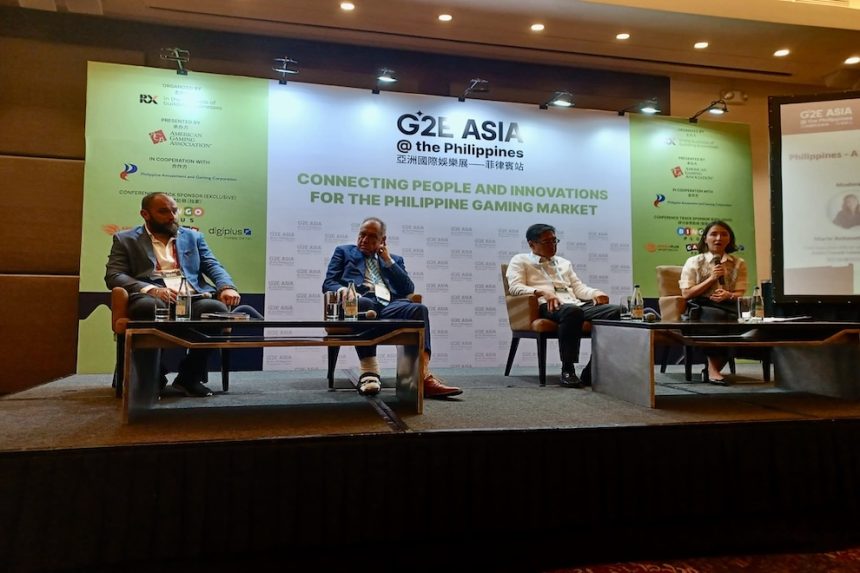
The Covid-19 pandemic was a turning point for speeding transfer online of many business activities including gambling, noted a panel at Global Gaming Expo (G2E) Asia @ the Philippines 2025.
The topic was “Philippines – A Leader in Offering Multi-platform Play from a Single Gaming Provider: How will that Evolve?”. GGRAsia acted as supporting collaborator for the content of the second day of the conference portion of the trade show.
The panel heard from industry experts about how a significant growth in online gaming played out in the Philippines. At first, the move was practical even for people who favoured traditional land-based casinos, as their favourite venues were shut during the pandemic for public health reasons, noted Ricardo Banaag, president and chief executive of DFNN Inc.
DFNN’s unit Inter-Active Entertainment Solutions Technologies Inc is the owner and operator of multiple online gaming licences. Products under the licences are Instawin and Xchangebet.
The panellists suggested that now worldwide, it is hard for land-based casinos to maintain a competitive offer for consumers without having their own online play services, in those jurisdictions where online gaming is permitted.
They said it would be hard now to put the online gaming ‘genie’ back in the bottle, as so many Filipinos spent time online and loved playing either social or casino games. Banning even the licensed online product would push consumers into dealing with a so-called ‘grey’ market of service providers that didn’t answer to the Philippine authorities. That issue had been discussed in a conference panel the previous day.
The Thursday panel was moderated by lawyer Marie Antonette Quiogue, chief executive and founder of Arden Consult International Pte Ltd, which advises the gaming sector in the Philippines.
Alongside Mr Banaag on the panel were Ken Jolly, vice president and managing director for Asia at gaming equipment and digital content provider Light & Wonder Inc, which provides slot games for the land-based and online sectors.
Also speaking was Artur Manasaryan, deputy head of business development at business-to-business gaming services provider, BetConstruct, which has worked with Philippine-licensed sports betting brand Jade SportsBet.
Remote gaming
DFNN’s Mr Banaag noted that during the Covid-19 pandemic, over a short period of time, social games and casino-style games became available on apps of digital payment platforms, and the Philippines was no exception.
He stated: “In the pandemic the meteoric rise of payment platforms happened as everyone couldn’t go out.”
In December 2020, amid the pandemic, the country’s regulator, the Philippine Amusement and Gaming Corp (Pagcor), had affirmed some Entertainment City casino resorts in Manila had Philippine Inland Gaming Operator (PIGO) permissions to offer remote gaming from their premises to domestic customers.
DFNN’s Mr Banaag noted in the discussion session: “The key then was that the regulatory framework … was really offering the players of land-based outlets an opportunity to get on a remote gaming platform.”
He added, referring to Pagcor’s Gaming Site Regulatory Manual (GSRM) system: “That’s why the current GSRM regulation is that every player who registers online has to be registered to a land based” outlet.
In August this year, the Philippines’ central bank ordered electronic wallets (e-wallet) services in the country – some of which had aggregated app-based gambling providers via their payment platforms – to delink their payment services from gaming sites.
Ms Quiogue noted that – in terms of all forms of Philippine consumer services that had migrated to online payment as a result of the pandemic – “at one point, the biggest e-wallet provider said there were 94 million [e-wallet] users out of a population of 112 million” in the country.
Online market ‘explosion’ post-pandemic
Light & Wonder’s Mr Jolly noted in the panel discussion: “When the pandemic came along, people didn’t come to the casinos, so what could they do? It was remote gaming.”
This had led to “an explosion” of services involving “machines that were on cameras on premises somewhere, that people could dial in and play”.
The online product had now typically moved into a purely digital offering, because of the “cost of infrastructure and buying machines and putting them in a remote situation,” suggested Mr Jolly.
BetConstruct’s Mr Manasaryan said that globally the pandemic had shrunk the time frame for gaming to migrate to a typically online format, from “10 to 15 years,” to “two or three”.
“After Covid, within two, three years, everyone started going online and we still see that movement. I don’t believe there are many [gaming] brands even in Philippines who are still sticking with only the offline. It is not even a choice. I think that’s mandatory” from a business perspective, he added.
Mr Manasaryan also observed that strong self-exclusion protocols could help in developing a sustainable licensed online industry in a regulated market.
He stated: “In the United Kingdom, if you self-exclude from one website, none of the thousands of regulated websites in the U.K. are allowed to let you play.”
Nonetheless, he also noted that “within the last 10, 15 years, so many people” in the U.K. market “self-excluded,” and this meant some had been “looking for [other options]” to continue gambling.
That was why, said the BetConstruct executive, “it’s very important to keep these rules,” to protect consumers.