The Singapore casino operation of Las Vegas Sands Corp (LVS) “powers ahead”, and while Macau gaming operators have seen growth in top-line performance, their costs in the fourth quarter have escalated, says an earnings preview from Seaport Research Partners.
Senior analyst Vitaly Umansky wrote in a Wednesday memo that Las Vegas Sands, “should benefit from both Macau growth (Sands China) and from its dominant Singapore market position in the long run”.
A recent note from Citigroup mentioned cost pressures faced by Macau operators.
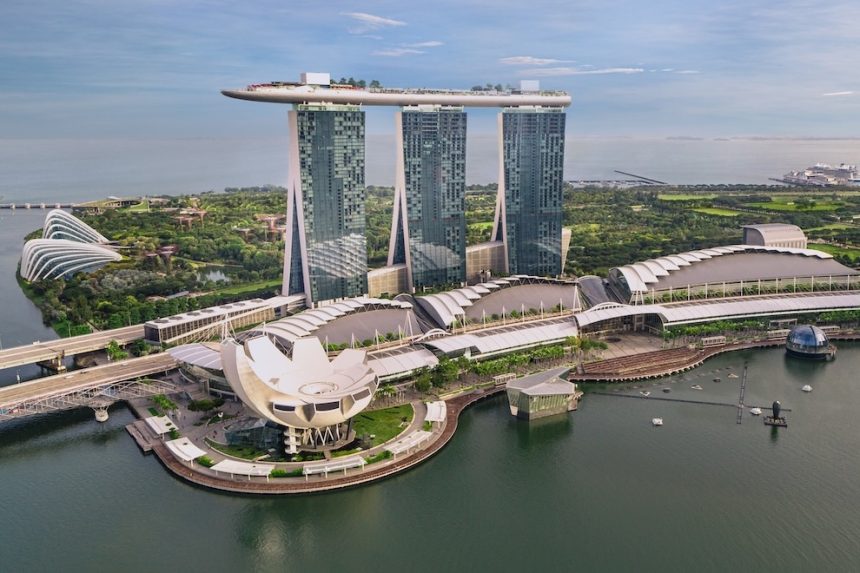
In his memo, Seaport’s Mr Umansky highlighted the benefits of Las Vegas Sands’ Asia-Pacific diversification via its Singapore property Marina Bay Sands (pictured).
He wrote, referring also to Las Vegas Sands’ competitor there, Resorts World Sentosa, promoted by Genting Singapore Ltd: “The Singapore market remains strong, and Marina Bay Sands has benefitted from its premium positioning, dominating against a weak competitor in a duopoly market.”
“Marina Bay Sands has strongly beaten expectations, especially over the last two quarters (and we expect it to do so in the fourth quarter as well), with strong performance expected in the coming quarters,” he added.
Mr Umansky also referred to the fact Las Vegas Sands chairman and chief executive Robert Goldstein will step down and move to an advisory role in March this year.
The analyst added: “While the Sands management bench is deep, losing Goldstein with his 45-plus years of gaming experience… may lead to some management concerns.”
Seaport said it expected Las Vegas Sands to continue to buy back stock “and grow its dividend,” and added that Sands China “will likely increase its dividend as business improves”.
Mr Umansky said that while Sands China had “lost share” in Macau in late 2024 and in the second half of 2025, the company had been “regaining share in the last two quarters as it has been reworking its marketing and player reinvestment strategy”.
The analyst also noted Sands China had been “restructuring some of its management in Macau and initiating new marketing and player reinvestment strategies which are positive catalysts to gain share and improve margins over the next few quarters.”
Macau operators
Mr Umansky stated regarding Galaxy Entertainment Group Ltd, and referring to its flagship Cotai resort: “Galaxy is set to be a long-term winner in Macau as Galaxy Macau Phase 3 continues to ramp up (with the ultra-luxury Capella opening last year) and longer term, Phase 4 slated to open in 2027.”
He added: “Galaxy has continued to gain share during 2025 and will see a more meaningful share jump when Phase 4 opens.”
Though he also stated that while the casino firm had a “stellar balance sheet” in terms of net cash, Seaport would “prefer Galaxy [Entertainment] increase its debt level modestly as the strong asset base warrants a cheaper capital foundation, which would also allow Galaxy to return more capital to shareholders, with either buybacks or greater dividends.”
Mr Umansky added: “With continued free cash flow growth, we expect Galaxy [Entertainment] to raise its dividend in 2026.”
Regarding Melco Resorts & Entertainment Ltd, the Seaport Research memo said: “Melco was viewed as a turnaround story last year, with new senior management in Macau hoping to make changes to marketing and operations that would drive share gain.”
The institution added, referring to that company’s main Macau properties in Cotai: “The changes implemented at City of Dreams and Studio City have been bearing fruit, but Melco has faced share pressure in the second half (and especially in the fourth quarter), but we believe this is only temporary.”
Smart table competition
For MGM China Holdings Ltd, the brokerage observed, referring first to pre-pandemic performance of the company: “Compared to 2019, MGM [China] has gained approximately 600 basis points of market share as it was well positioned to capture premium play and had a first mover advantage with smart digital tables.”
Nonetheless, the firm faced “headwinds in market share in the coming years as [other] operators go after MGM’s outsized share position and begin benefitting from smart digital tables and new property offerings.”
With regard to SJM Holdings Ltd, Seaport stated: “SJM remains poorly positioned in a very competitive Macau market.”
Mr Umansky added, referring to the legacy satellite casino system that was phased out by year-end: “We expect SJM to be the biggest market share loser in the fourth quarter and lose share in 2026 as the satellite business have now been shut down.”
The analyst added that the institution had “some concerns around SJM’s debt levels at this stage – especially with the slow ramp up at Grand Lisboa Palace” resort in Cotai.
Mr Umansky further noted: “The recent bond refinancing was completed at a materially higher cost. SJM has no ability to restart its dividend any time in the foreseeable future, which was a key element of its shareholder appeal prior to Covid.”
At Wynn Macau Ltd, that company had been “aggressively defending its market share in Macau after a weak second quarter followed by a stronger second half,” said Mr Umansky.
The analyst added, regarding the parent Wynn Resorts Ltd and its investment in Wynn Al Marjan Island in the United Arab Emirates (UAE), due to launch in first-quarter 2027: “As investors get more comfortable with the UAE, we expect Wynn to see price support as we move closer to opening.”