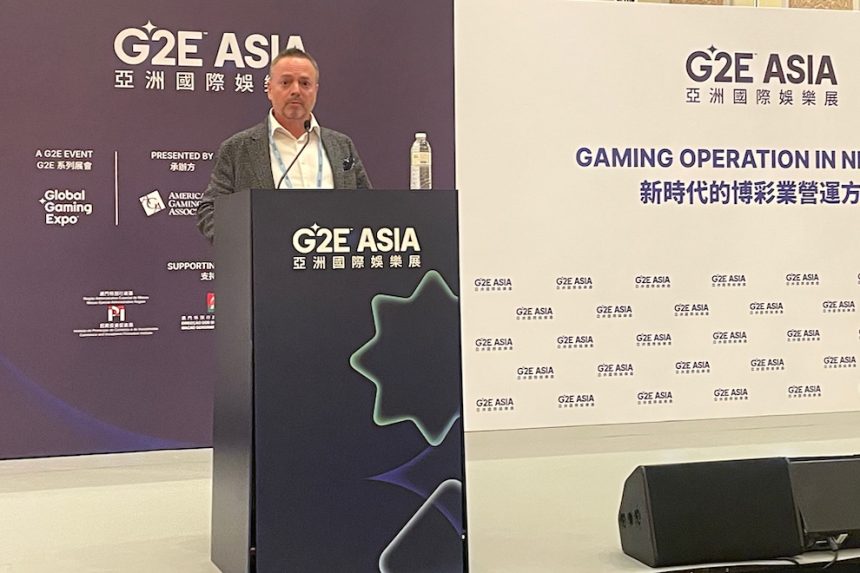
Ed Bowers (pictured), president of global development at casino operator MGM Resorts International, says the national government in Japan is “actively working” on a fresh process round for integrated resorts (IRs) with casinos, with the hope of approving two new licences.
So far, only one such IR – the MGM Osaka – has been approved, even though Japan’s enabling framework had anticipated up to three licences being issued.
MGM Resorts and Japan’s Orix Corp are the two main partners in the consortium developing MGM Osaka. The project also involves a number of other Japanese businesses as minority investors.
Japan’s national government is said to have a policy aim of starting this year a fresh process round for new IR licences, with the hope of approving “by December 2027” as many as two new locations. GGRAsia had reported in March – based on multiple sources – that the new application process proper might start in 2026.
“Given Japan’s methodical approach to this [licensing process], this will likely take time, and I do not anticipate any new concession awards for at least the next two to three years, judging by the speed of which the first concession was awarded,” stated Mr Bowers.
He made the remarks during a speech on Wednesday, on the first day of this year’s Global Gaming Expo (G2E) Asia event in Macau.
A ground breaking ceremony for MGM Osaka was held on April 24. Construction of the complex is expected to be completed in the summer of 2030, with the opening scheduled for around autumn of that same year.
The casino project – which has been described by MGM Resorts as a JPY1.27-trillion (US$8.86-billion currently) venture overall – is being developed at Yumeshima, an artificial island in Osaka Bay.
“We already have ongoing site work and preparatory construction work,” confirmed Mr Bowers on Wednesday.
According to the executive, the project will feature three hotels providing in total approximately 2,500 rooms, a 3,500-seat theatre, and “various Japanese cultural experiences”, as well as a large number of food and drink outlets, and shops.
“The casino will accommodate 470 table games and 6,400 slot machines and would likely be one of the highest-revenue generating casinos in the world,” observed Mr Bowers.
He said MGM Osaka’s benefit to the economy “will be considerable,” with significant contributions to the local authorities, namely via casino taxation.
“We expect the project to contribute approximately JPY106 billion [US$739.6 million currently] annually to the city,” stated Mr Bowers. “We’re also contributing equal amounts to Japan’s national government.”
According to the executive, the MGM Osaka project “has had to deal with the overly complex regulatory and legal framework established in Japan” regarding the development of IRs in the country. Another challenge, he added, was the “rising construction costs” for the project.
In late April, Jonathan Halkyard, MGM Resorts’ chief financial officer, said the company’s equity commitment for MGM Osaka had increased to JPY428 billion.
“We now have remaining about JPY392 billion to invest for our future 43.5-percent ownership stake” in MGM Osaka, stated the CFO.
“Despite the increase driven by updated spend estimates as we finalised our negotiations with contractors, we still have a high conviction in a high-teens percentage return on this project and remain on time to open in 2030,” he added.
Mr Halkyard also said the casino group had “already hedged over half” of its commitments to the project in the “forward yen markets,” in order “to lock in some of these favourable exchange rates”.
He added: “So, we’re all fully hedged through the middle of 2027 in terms of our equity contributions.”
On Wednesday, Mr Bowers said: “Going forward, I believe the major challenges will be securing post-opening labour, and working constructively with Japan’s regulators to ensure that the operating environment adheres to other countries best practices and is not uniquely restricted.”