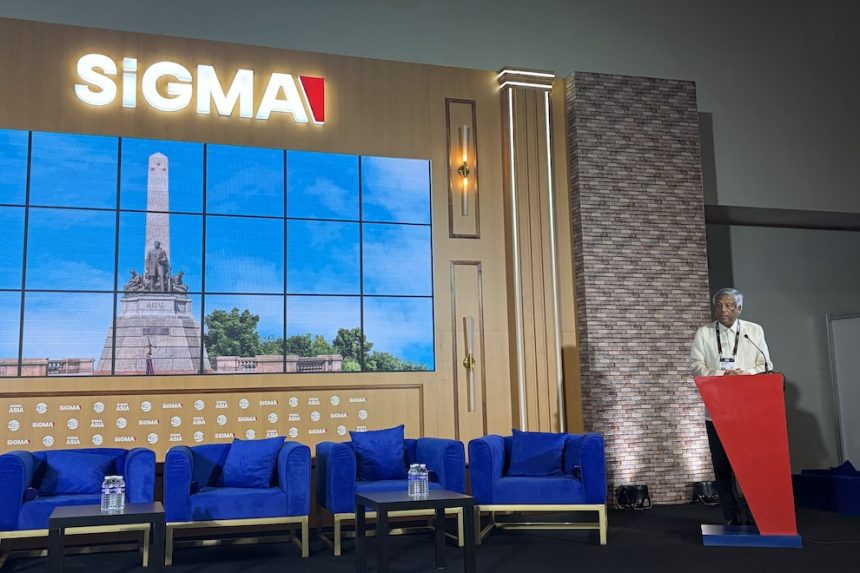
The chairman and chief executive of the Philippine gaming regulator, Alejandro Tengco, has highlighted the resilience of the country’s land-based casino sector amid a slowdown in the growth of the electronic gaming sector. Speaking on Tuesday at an industry gathering in Manila, he also said the agency was looking at regulating the e-sports segment as part of the nation’s gaming ecosystem.
The head of the Philippine Amusement and Gaming Corp (Pagcor) told the audience that the agency was “trying to study” whether it “could regulate e-sports”.
“In today’s world, e-sports is one of the important facets that the young generation is involved in,” he noted.
Mr Tengco (pictured) made the remarks at the opening session of SiGMA Asia 2026, a trade show and conference for the online gaming industry taking place this week in the Philippine capital.
The Pagcor chief also made a reference in his speech to the volatility impacting the Philippine gaming industry in the current year, particularly in the country’s electronic gaming sector.
Mr Tengco recalled that the industry – including non-casino operations – generated gross gaming revenues (GGR) of PHP396.14 billion (US$6.42 billion) in full-year 2025, a 6.4-percent increase from the previous year.
The 2025 performance, he noted, was largely driven by the rapid expansion of the electronic gaming segment, which surpassed land-based casinos as the industry’s largest revenue contributor.
However, he said that momentum in the sector had weakened in early 2026 amid geopolitical tensions and economic uncertainty.
“Since the Middle East crisis, the momentum has been totally moderated in the first quarter of 2026,” Mr Tengco stated.
The Philippine gaming sector produced GGR of PHP87.60 billion in the first three months of 2026, 15.9-percent lower than in the prior-year period. The decline was largely driven by a “weaker performance” of the electronic gaming sector, which saw revenue down 22.4 percent from a year ago.
Such contraction, Mr Tengco said, was mainly due to “softer discretionary spending, and broader economic pressures”.
“In contrast, land-based casinos have shown greater stability, generating PHP45 billion in GGR, representing 51 percent of the total GGR in the first quarter of 2026,” he noted.
“These developments remind us of how unpredictable the gaming industry could be,” the Pagcor chairman added.
The official described the development as evidence of the industry’s “cyclical nature”, with digital gaming typically leading growth phases, “while traditional casino operations continue to provide resilience during periods of market adjustments”.
Mr Tengco also emphasised that the industry’s success should not be measured solely by revenue growth.
“The true measure of this industry is not simply size or rate of expansion, but our ability to ensure that gaming remains properly regulated, socially responsible, and genuinely beneficial to the communities we all serve,” he stated.
He reiterated Pagcor’s commitment to strengthening regulatory oversight through enhanced compliance measures, stricter supervision and efforts to maintain a level playing field for legitimate operators.
Mr Tengco also highlighted what he described as one of Pagcor’s “most significant achievements” this year: the launch of the National Problem Gambling Helpline.
He urged regulators, operators and suppliers to ensure “innovation is matched by accountability and that industry growth remains aligned with social responsibility and public welfare”.