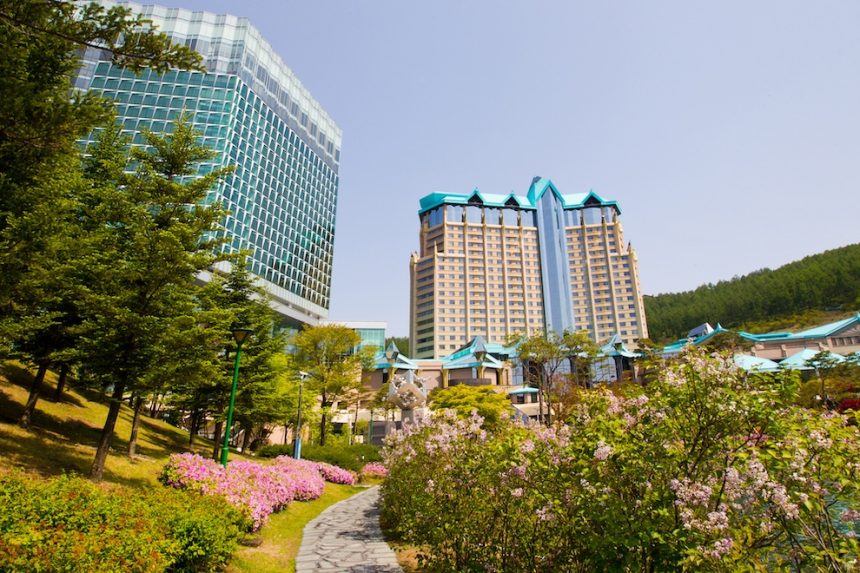
Kangwon Land (pictured in a file photo), a resort with South Korea’s only casino that allows locals to bet, saw in March construction begin on a second casino venue at the complex. It will help address ‘overpopulation’ in the main gaming area, said a spokesman for the resort’s promoter, Kangwon Land Inc.
The targeted completion date is December 2027, according to Kim Hyukha, a general manager for the casino management team, in comments to GGRAsia.
The plan for the new casino area is to install “50 tables and 250 slot machines as well as food and drink facilities, possibly with keno and bingo,” stated Mr Kim, adding the facility had already been approved by the Ministry of Culture, Sports and Tourism. The body has a supervisory role in relation to the country’s casino sector.
The manager noted the new Kangwon Land casino was part of the company’s ‘K-HIT 1.0’ project. That is the name for an ongoing revamp of the complex, as part of Kangwon Land Inc’s efforts to help the resort address the competitive challenge of casinos in neighbouring countries that want to target South Korean players.
Kangwon Land – in a rural upland area around three hours east of Seoul – has traditionally had a strong customer base of domestic players. Business recovery had been slower than expected following the Covid-19 pandemic, noted Mr Kim in other comments to GGRAsia.
The second casino venue will cover 5,748 square metres (61,871 sq. feet)
Aside from the second casino, the company aspires to see the gaming footprint at the Kangwon Land resort expand eventually to 49,500 sq. ms. That would be nearly 320 percent of the current gaming operation footprint of 15,486 sq. ms.
Regarding the location for the second casino, Mr Kim noted: “We had an empty space [land] near the current casino venue – a former theme park – and since we were looking for [a site] where we could start construction quickly, we decided to construct” it there.
He added: “This expansion would solve the [current] venue’s ‘overpopulation’,” and once it’s up “we could look forward to welcoming new customers.”
But the manager noted that as the current casino and the new venue will be separate, “we are still discussing how to connect both venues physically and systematically, for customer convenience such as them avoiding having to show an identification document again” to move from one gaming venue to the other.
Currently, locals must pay KRW9,000 (roughly US$6.14) and present an identity document to visit the Kangwon Land casino operation.
Mr Kim further noted: “We are also renovating the current [gaming] venue’s food and beverage facilities for the convenience of mass players.” He added that the company’s VIP-client food and drink services did not currently require any changes.
The company’s current effort regarding gaming at the Kangwon Land resort represented the early phases of the K-HIT 1.0 plan, observed Mr Kim.
He added there would be further consultation on it eventually with the Ministry of Culture, Sports and Tourism. For now, the company will adopt a conservative and methodical approach to its efforts to realise its K-HIT 1.0 initiative, said Mr Kim.