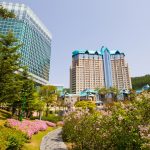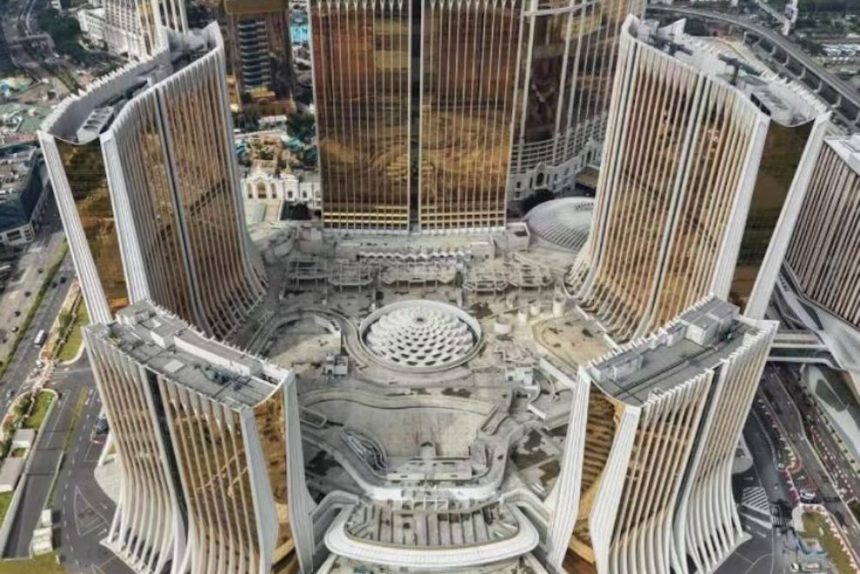
There are hopes that the under-development Phase 4 (pictured) at the Galaxy Macau resort in Macau’s Cotai district, will merit a fresh allocation of gaming tables from the city’s government. That is according to a memo from brokerage Jefferies, after an earnings call with management from the resort’s promoter Galaxy Entertainment Group Ltd.
Galaxy Entertainment reported its fourth-quarter and full-year results on Thursday. Galaxy Macau Phase 4, due to be completed in 2027, will be pitched to capture premium customers, noted management in a post-results press conference.
Gaming table allocation for Macau’s six casino concessionaires is in the hands of the city’s government.
Jefferies analysts Anne Ling and Jingjue Pei said in a Thursday memo there was “lobbying” of the government “to increase the number of gaming tables,” for Galaxy Entertainment, “as it is investing in another project (Phase 4). It is waiting for the final decision.”
Otherwise, the casino operator would “reallocate existing tables toward higher-yield areas”. That was an approach “similar” to what it had done at Horizon Plus, a premium gaming zone in the tower that houses the Capella at Galaxy Macau hotel, the Jefferies analysts noted.
Galaxy Entertainment’s financial results filing did not mention how many gaming tables have been deployed across its Macau properties during its latest reporting year. The casino operator has been permitted to operate 1,000 gaming tables and 1,700 gaming machines during its current gaming concession that started from January 1, 2023, according to a previous corporate announcement.
The Galaxy Phase 4 project – spanning 600,000 square metres (6.46 million sq. feet) – is said to feature an approximately 5,000-seat theatre, and a “water resort deck”, plus other non-gaming amenities as well as casino space.
Jefferies stated Galaxy Entertainment had “received customer feedback indicating a desire for premium products” and so had “decided to increase the room size in its Phase 4”. That would involve reducing the total number of hotel rooms and suites “to approximately 1,350, from 1,500 previously,” the Jefferies analysts noted.
The brokerage also cited guidance that the casino firm’s 2026 capital expenditure would be in the range of HKD10 billion (US$1.28 billion) and HKD11 billion. In 2025, it had spent HKD3.5 billion. The 2026 capex was to “enhance competitiveness”, and “update resorts” as well as for the development costs on Galaxy Phase 4, stated Jefferies.
EBITDA market share
Banking group JP Morgan said in its note following the earnings call, that Galaxy Entertainment regards market share in earnings before interest, taxation, depreciation and amortisation (EBITDA) as the key performance indicator. Jefferies also referred to that.
Jefferies stated: “Management commented that the Macau gaming market will remain highly competitive, especially in the premium mass segment.
“Its strategy is to differentiate through quality products and services, operational excellence, customer engagement, and technological innovation.”
JP Morgan analysts DS Kim, Selina Li, and Lindsey Qian said the institution estimated the casino operator’s share of Macau-market adjusted EBITDA had improved from 22 percent in 2024, to 24 percent in 2025, and might stay at that level this year and next. That would keep it second only to Sands China Ltd.
The JP Morgan team also said Galaxy Entertainment had shown discipline in managing its operating expenditures and had achieved “robust margin expansion”.
JP Morgan stated it was memorable that Francis Lui Yiu Tung, chairman of Galaxy Entertainment, was personally on the earnings call, although it noted that when he was asked about shareholder returns, “a key investor focus,… specific commitments were limited”.
Though the institution said Mr Lui “stressed full alignment between major shareholders (i.e., himself and family) and minority investors – notably with no intermediate holding company, unlike peers”.
JP Morgan said it thought that regarding dividends, “the door remains open for further hikes, in our view, from circa 65 percent payout in second half of 2025, compared to “58 percent in first half of 2025,” and “50 percent in 2024” and “32 percent in 2023”.