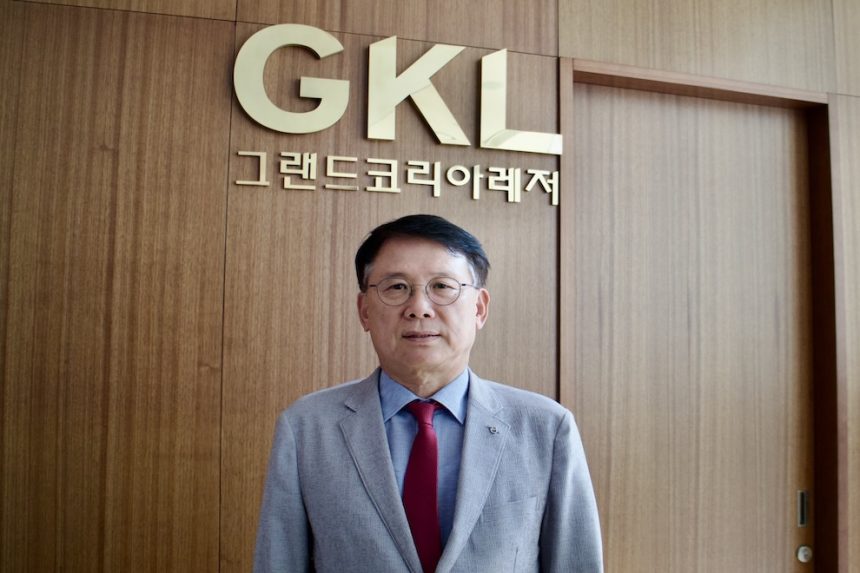
The chief executive of Grand Korea Leisure Co Ltd (GKL) has told GGRAsia in an interview, the company is monitoring a major port redevelopment in the South Korean city of Busan to see if it might be a good location for a foreigner-only casino.
“We are watching closely, but nothing is fixed,” said Yoon Doo-hyun (pictured). The company presently runs a casino operation at the Lotte Hotel Busan.
The government in the southeastern city is leading the Busan North Port Redevelopment Project, which features a cruise terminal. The budget for phase one of the multi-year scheme – including a waterfront park and commercial and business facilities – is KRW8.5 trillion (US$5.83 billion), according to a Busan Metropolitan City website about the project.
GKL runs Seven Luck-branded casinos in South Korea, and marked its 20th anniversary in September.
The Korea Exchange-listed casino group is 51-percent owned by the Korea Tourism Organization, affiliated with the Ministry of Culture, Sports and Tourism. It operates three properties: two in the country’s capital Seoul, at Gangnam COEX, and at Dragon City; and one at Busan Lotte.
GGRAsia asked Mr Yoon whether the company might consider the semi-autonomous island of Jeju for a casino operation.
He stated: “The Jeju market is already saturated, since the island has eight casino licences, with most properties struggling to remain profitable.”
Philippines-listed Bloomberry Resorts Corp announced last month a deal to dispose of its loss-making Jeju Sun operation with hotel and foreigner-only casino on Jeju.
Regarding the structure of GKL’s current business, Mr Yoon said VIP players account for about 10 percent of its customers, but more than 70 percent of sales.
The CEO said that Japan is the company’s largest source market for clients, and that segment is supported by the company’s liaison offices in Tokyo and Osaka, to market to Japanese clients. Additionally, customers from Taiwan and from Southeast Asia often arrive under visa-waiver schemes via package tours.
Clients from the Chinese mainland remain important for the Seoul and Busan markets as well, though group tourism from China remains sensitive to public policy on visas and visa-free travel, said Mr Yoon.
GKL also connects to customers based in North America and Europe through cultural events, while foreigners resident in South Korea – as well as “Korean Chinese”, people ethnically Korean but living in China – are engaged via information sessions and tailored promotions.
Regarding the mass versus VIP segments, Mr Yoon commented: “VIPs provide volume, but mass customers will sustain us when headwinds hit.”
He added: “The Gangnam COEX venue [pictured, below] remains GKL’s flagship, its prestige location keeps it VIP-oriented, while Dragon City, is repositioning as more mass-market focused, testing product mixes and promotions suited to urban visitors and business travellers.”

AI and other digital technology
According to Mr Yoon, GKL aims to expand into cultural tourism and digital services. Its new “AI [artificial intelligence] innovation team” – launched in September – is developing tools such as predictive data systems, upgraded apps and kiosks, and autonomous robots for delivery of some services.
The company is also seeking to offer visitors broader experiences, including what it terms beauty tourism and K-culture programmes. For its 20th anniversary, GKL has been emphasising sustainability, environmental, social and governance practices, and workplace safety, noted the CEO.
In terms of regulatory compliance and responsible gambling policy, Mr Yoon suggested GKL’s public-sector links meant it adhered to stricter standards than might be the case for purely private-sector operators. That included the level of identification proof required to qualify as a foreign player.
GKL’s CEO highlighted the role of its programmes enabling gambling clients to opt for a “self-ban”. First requests typically last three months, while repeat requests extend to six months. Family-initiated bans are possible, provided the person or people making the request, are bona fide family members and that can be proven. “Our goal is to prevent addiction without undermining trust,” said Mr Yoon.
GKL is advancing digitalisation via a partnership with the Korea Minting and Security Printing Corporation (KOMSCO) and technology firm Sooho IO. Initiatives include digital watermarking in the “SevenLuck Plus” mobile app for secure promotions and ticket authentication. Other approaches cover exploration of digital payment and voucher systems for foreign visitors; and AI-driven tools for fair play monitoring, baccarat data logging, and customer-behaviour analysis.
GKL’s management says its AI innovation team is to pursue predictive data systems, self-service kiosks, and integration with autonomous robots for delivery of some services.
“Robotics are no longer theory,” said Mr Yoon. “We are already piloting AI-powered robots in customer service, guidance, and multilingual support. These tie into broader AI systems monitoring games, fairness, and operational efficiency.”
He envisions GKL as the world’s first fully AI-driven casino operator. “Robotics and AI will reduce human error, strengthen fairness, and position the country as a global casino-tech innovator. We can contribute not just to tourism, but to national industrial competitiveness,” he added.
“Our mission is not chasing scale,” Mr Yoon said. “It is about running fairly, and strengthening the country’s tourism and overall industries.”